
Explained | Single-Family Home Loans
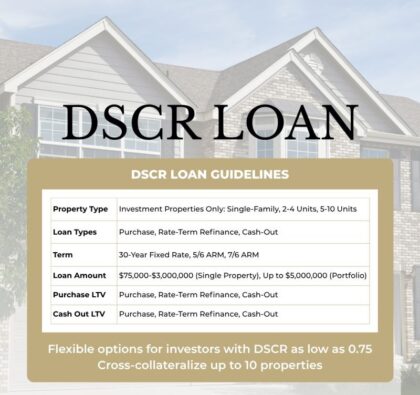
DSCR Loans for Single-Family Homes: Your Personal Income Doesn’t Matter — The Property’s Does
The Best-Kept Secret in Real Estate Investing
Here’s something that most everyday real estate investors don’t know:
You can qualify for an investment property loan on a single-family home or condominium — and your personal income, your tax returns, your W-2s, and your pay stubs are never even looked at.
That’s not a loophole. That’s not too good to be true. That is exactly how a DSCR loan for single-family residential investment properties works — and it is one of the most powerful and underutilized financing tools available to the everyday “mom and pop” real estate investor today.
If you have ever been told:
- ❌ “You don’t show enough income on your tax returns”
- ❌ “Your debt-to-income ratio is too high”
- ❌ “You already have too many financed properties”
- ❌ “We can’t use your rental income to qualify”
…then a Single-Family DSCR loan may be exactly what you have been looking for.
What Is a DSCR Loan on a Single-Family Home?
A Debt Service Coverage Ratio (DSCR) loan on a single-family home or condominium is an investment property mortgage that qualifies you based entirely on one simple question:
Does the rent the property generates cover the mortgage payment?
That’s it. The lender is not interested in where you work, how much you earn, or what your tax returns look like. They are focused exclusively on the income performance of the property itself — making this loan type a complete game-changer for real estate investors of all experience levels.
The DSCR Formula — Kept Simple:
DSCR = Monthly Rental Income ÷ Monthly Loan Payment (PITIA)
(PITIA = Principal, Interest, Taxes, Insurance, and Association dues if applicable)
| DSCR Result | What It Means |
|---|---|
| Below 1.0 | Rent does not fully cover the payment — may still qualify with some lenders |
| 1.0 | Rent exactly covers the payment — break-even coverage |
| 1.10 – 1.25 | Rent exceeds the payment — solid qualification range |
| 1.25+ | Strong cash flow — best rates and terms available |
Real-World Example: You are purchasing a single-family rental home. The market rent is $2,200/month. Your total monthly mortgage payment (PITIA) is $1,800/month.
DSCR = $2,200 ÷ $1,800 = 1.22 ✅
That is a qualifying DSCR — and not one line of your personal income was used to get there.
Your Personal Income Is Never Considered — Here’s Why That Matters
This is the point that stops most investors in their tracks when they first hear it — so let us say it clearly and directly:
🚫 The following are NOT required for a Single-Family DSCR loan:
- ❌ W-2 income statements
- ❌ Personal tax returns (1040s)
- ❌ Pay stubs or employer verification
- ❌ Personal debt-to-income (DTI) ratio calculation
- ❌ Employment history or job stability review
- ❌ Business tax returns or profit & loss statements
✅ What IS used to approve your loan:
- ✔️ The property’s monthly rental income
- ✔️ The proposed monthly mortgage payment
- ✔️ Your credit score
- ✔️ Your down payment
- ✔️ The property’s appraised value
This distinction is enormously significant for a wide range of investors — particularly those whose personal financial picture does not reflect their true wealth-building ability or investment savvy.
How Does the Rental Income Get Determined?
One of the most common questions investors ask is: “What if the property doesn’t have a tenant yet?”
Great news — you do not need an existing tenant or active lease to qualify for a DSCR loan. Lenders use one of two methods to establish rental income for qualification purposes:
📋 Method 1: Existing Lease Agreement
If the property already has a tenant in place, the lender will use the current signed lease agreement to document and verify the monthly rental income. This is the most straightforward scenario.
📊 Method 2: Market Rent Appraisal (Form 1007)
If the property is vacant or you are purchasing a home without a tenant, the lender will order a 1007 Rent Schedule — a standard appraisal addendum completed by a licensed appraiser that establishes the fair market rent for the property based on comparable rentals in the area.
This means you can qualify for a DSCR loan on a property before you ever find a tenant — based purely on what the market says it should rent for.
How Do You Qualify? The Full Breakdown
Single-Family DSCR loans have a streamlined qualification process compared to conventional investment property loans. Here is exactly what is evaluated:
1. 🏠 Property Type Eligibility
DSCR loans are available for:
- ✅ Single-family homes (1 unit)
- ✅ Condominiums
- ✅ Townhomes
- ✅ 2–4 unit small multi-family properties (duplex, triplex, fourplex)
- ✅ Short-term rental properties (Airbnb / VRBO eligible on many programs)
- ✅ Warrantable and non-warrantable condos (program dependent)
2. 📊 DSCR Calculation & Minimum Ratio
- Most lenders require a minimum DSCR of 1.0 to 1.25
- Some lenders offer “No Ratio” DSCR programs for DSCRs below 1.0, accepting that the investor may cover a small gap between rent and payment — a common and acceptable scenario for investors focused on appreciation
- Higher DSCRs unlock better interest rates and more favorable terms
3. 💳 Credit Score Requirements
While your income is irrelevant, your credit score does matter:
| Credit Score Range | Typical Impact |
|---|---|
| 740+ | Best available rates and terms |
| 700 – 739 | Very competitive rates |
| 660 – 699 | Standard qualification — moderate rates |
| 620 – 659 | Minimum range for most programs — higher rates apply |
| Below 620 | Limited options — specialty programs only |
4. 💰 Down Payment Requirements
Single-Family DSCR loans are investment property loans — not primary residence mortgages — so down payment requirements reflect that:
| Scenario | Typical Down Payment |
|---|---|
| Single-Family Home Purchase | 20–25% |
| Condominium Purchase | 20–25% |
| 2–4 Unit Property Purchase | 20–25% |
| Short-Term Rental Property | 25–30% |
| Cash-Out Refinance | 25–30% equity retained |
| Rate & Term Refinance | 20–25% equity retained |
5. 🏦 Reserves & Liquidity
Most DSCR lenders want to see that you have liquid financial reserves after closing — typically:
- 3 to 6 months of the total mortgage payment (PITIA) held in a verifiable account
- Reserves demonstrate that you can handle unexpected vacancies or repairs without defaulting on the loan
- Retirement accounts, savings, and investment accounts typically qualify as reserves
6. 🏘️ Property Condition & Appraisal
The property must:
- Be in rentable, habitable condition at the time of closing
- Appraise at or above the purchase price
- Meet the lender’s property condition guidelines
- Be a non-owner-occupied investment property — DSCR loans are strictly for investment purposes, not primary residences
7. 📜 Entity or Personal Borrowing
DSCR loans offer flexibility in how you hold title:
- ✅ You can borrow in your personal name
- ✅ You can borrow through an LLC or other business entity — a major advantage for investors who hold properties in LLCs for liability protection
- This is another area where DSCR loans outperform conventional financing, which typically cannot be placed in an LLC
Who Is the Single-Family DSCR Loan Perfect For?
This loan was practically designed with the everyday real estate investor in mind. Here are the people who benefit most:
👨👩👧 The “Mom & Pop” Landlord
You own one or two rental homes and want to expand your portfolio — but every time you apply for a conventional loan, the bank says your income isn’t high enough because of all the deductions on your tax returns. Sound familiar? A DSCR loan sees past your tax return and focuses entirely on whether your properties cash flow. This is your loan.
💼 The Self-Employed Investor
You run your own business. You write off everything legally possible. On paper, your income looks modest — but your actual financial life tells a very different story. DSCR loans don’t care about your Schedule C or your write-offs. They care about the rent check coming in every month.
📈 The Portfolio Builder
Conventional lenders typically cap borrowers at 10 financed properties. DSCR lenders often have no such limit — allowing aggressive portfolio builders to keep scaling without hitting an artificial ceiling on their real estate ambitions.
🏖️ The Short-Term Rental (Airbnb) Investor
You’ve discovered the power of short-term rentals and want to acquire more properties for platforms like Airbnb or VRBO. Many DSCR programs now accommodate short-term rental income using platforms like AirDNA to document market-rate STR revenue — a game-changer for vacation rental investors.
🌎 The Out-of-State Investor
You live in an expensive market but invest in cash-flowing markets across the country. DSCR loans are available nationwide and do not require you to invest locally — giving you the freedom to chase the best returns wherever they exist.
🔄 The BRRRR Strategy Investor
You buy, rehab, rent, then want to refinance and pull your capital back out. A DSCR loan is the perfect refinance vehicle for the BRRRR strategy — once the property is renovated and tenanted, you refinance based on its new appraised value and rental income, not your personal income.
👴👵 The Retired or Fixed-Income Investor
Retirement income, Social Security, and investment distributions can make conventional loan qualification difficult — even for financially strong individuals. Since DSCR loans completely ignore personal income, retirees and fixed-income investors can qualify based entirely on what their properties earn.
🏦 The High-Net-Worth Investor Who Prefers Privacy
Some investors simply prefer not to disclose the full extent of their personal finances. DSCR loans offer a cleaner, more private path to investment financing that keeps personal income documentation out of the equation entirely.
Single-Family DSCR Loan vs. Conventional Investment Property Loan
| Feature | DSCR Loan | Conventional Investment Loan |
|---|---|---|
| Personal Income Required | ❌ Never | ✅ Always |
| Tax Returns Required | ❌ No | ✅ 2 Years Required |
| Pay Stubs / W-2s Required | ❌ No | ✅ Required |
| DTI Ratio Calculated | ❌ No | ✅ Strictly Enforced |
| LLC Borrowing Allowed | ✅ Yes | ❌ Rarely |
| Property Limit | ✅ Unlimited (most programs) | ❌ Capped at 10 |
| Qualification Speed | ✅ Faster | ❌ Slower |
| Self-Employed Friendly | ✅ Very | ❌ Complicated |
| Short-Term Rental Income | ✅ Accepted | ❌ Rarely Accepted |
| Qualification Based On | Property Cash Flow | Personal Income & DTI |
Common Myths About Single-Family DSCR Loans — Debunked
❌ Myth: “DSCR loans are only for large commercial properties or big investors.”
✅ Truth: DSCR loans are available on single-family homes, condos, and small multi-family properties — making them accessible to first-time and small-scale investors alike.
❌ Myth: “The interest rates are outrageously high compared to conventional loans.”
✅ Truth: While DSCR loan rates are typically slightly higher than primary residence mortgage rates, they are very competitive within the investment property space — and the flexibility and accessibility they offer more than justify the modest rate difference for most investors.
❌ Myth: “I need to already have tenants in place to qualify.”
✅ Truth: A market rent appraisal (Form 1007) can establish qualifying rental income on a vacant property — no tenant required at the time of application or closing.
❌ Myth: “These loans have hidden fees and predatory terms.”
✅ Truth: DSCR loans are mainstream investment property financing products offered by reputable lenders across the country — with transparent terms, standard closing costs, and straightforward structures.
❌ Myth: “I need perfect credit to qualify.”
✅ Truth: While better credit means better rates, many DSCR programs accept credit scores starting at 620 — making them accessible to a wide range of borrowers.
The Bottom Line
If you own a single-family home, a condo, or a small rental property — or if you are looking to purchase one — and you have been told that your personal income is a problem, the DSCR loan may be the single most important financing tool you have never heard of.
Your tax write-offs. Your self-employment. Your retirement income. Your existing financed properties. None of it matters.
What matters is simple: Does the rent cover the payment?
If the answer is yes — or even close to yes — there is very likely a DSCR loan program designed for exactly your situation.
Ready to Find Out If Your Property Qualifies?
You don’t need to overhaul your finances. You don’t need to dig up years of tax returns. You just need to have a conversation with our team — and we’ll tell you quickly and clearly whether a Single-Family DSCR loan is the right move for your next investment property.
Get Your Free DSCR Loan Assessment Today — tell us about the property, and we’ll run the numbers for you.
💬 It costs nothing to find out. It could cost you everything not to.
DSCR loan programs, rates, minimum ratios, down payment requirements, and eligibility guidelines vary by lender, property type, and borrower profile. Short-term rental income eligibility is program-specific. Contact us directly for a personalized loan analysis based on your specific property and investment goals.