
Explained | Mixed-Use Commercial Loans
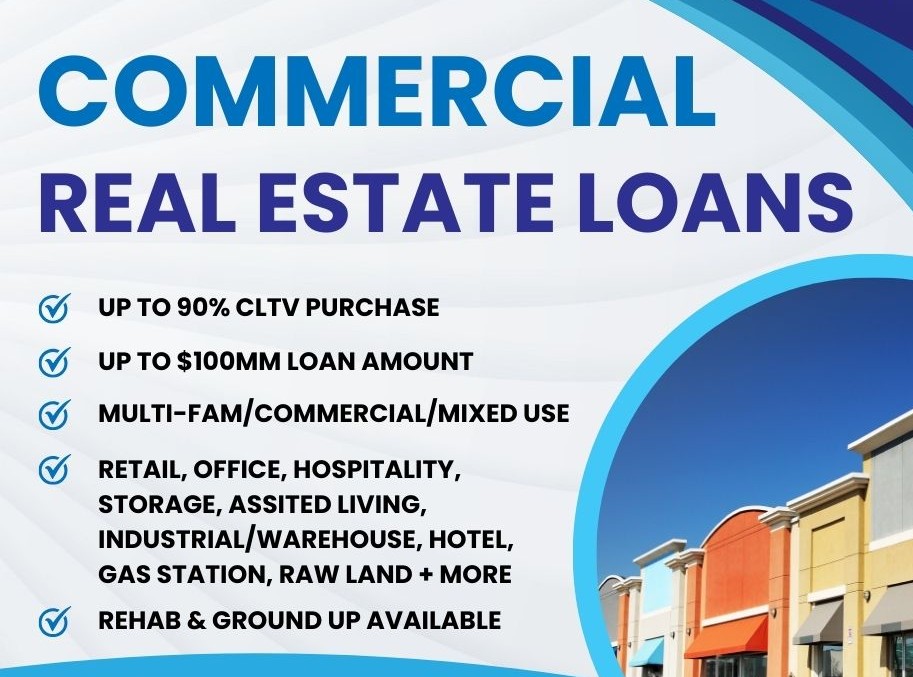 Commercial Real Estate Loans: Financing Mixed-Use & Income-Producing Properties
What Is a Commercial Real Estate Loan?
A Commercial Real Estate (CRE) loan is a mortgage or financing instrument secured by income-producing or business-purpose real property — as opposed to residential loans designed for personal homeownership. Commercial real estate loans are used to purchase, refinance, renovate, or cash-out equity from properties that generate revenue through leases, business operations, or a combination of both.
Unlike residential mortgages that focus heavily on personal income and credit, commercial real estate lending is fundamentally rooted in one core principle: the property’s ability to generate sufficient income to support the debt.
This category of lending covers an enormous range of property types, including:
- 🏪 Retail strip centers and shopping plazas
- 🏢 Office buildings and professional complexes
- 🏨 Hotels, motels, and hospitality properties
- 🍽️ Restaurants and food service establishments
- 🏗️ Mixed-use developments (retail + residential)
- 🚗 Gas stations, car washes, and auto-related properties
- 🏥 Medical offices and healthcare facilities
- 🏭 Light industrial and flex-space properties
- 🛒 Free-standing retail (net lease properties)
- 🌆 Urban infill and repositioning projects
The Core Principle: Commercial real estate lending is about the performance of the asset — the income it generates, the tenants it attracts, the market it serves, and the long-term value it holds.
How Does Commercial Property Income Factor Into Qualification?
This is where commercial lending differs most significantly from residential financing — and where having an experienced lending partner makes all the difference.
📊 Net Operating Income (NOI) — The Foundation of Qualification
The single most important number in commercial real estate underwriting is the property’s Net Operating Income (NOI):
NOI = Gross Income − Operating Expenses
(Operating expenses include property taxes, insurance, maintenance, management fees, utilities, and reserves — but NOT the mortgage payment itself)
The NOI tells the lender how much cash the property produces before debt service, and it becomes the basis for determining how large of a loan the property can support.
📐 Debt Service Coverage Ratio (DSCR) — Can the Property Pay Its Own Debt?
Once NOI is established, lenders calculate the Debt Service Coverage Ratio (DSCR):
DSCR = NOI ÷ Annual Debt Service (Mortgage Payments)
| DSCR | What It Signals |
|---|---|
| Below 1.0 | Property does not generate enough income to cover the loan — high risk |
| 1.0 | Property income exactly covers the mortgage — minimal cushion |
| 1.20 – 1.25 | Typical minimum threshold most lenders require |
| 1.35+ | Strong coverage — favorable loan terms and higher leverage potential |
Example: A retail strip center generating $180,000 in NOI with annual debt service of $140,000 produces a DSCR of 1.28 — above the typical minimum threshold and likely to qualify for favorable terms.
🏢 How Different Property Types Generate & Report Income
Not all commercial properties generate income the same way, and experienced lenders understand the nuances of each:
🏪 Retail Strip Centers & Shopping Plazas
Income is derived from tenant lease agreements — evaluated based on:
- Current rent rolls and lease terms
- Tenant creditworthiness and business strength
- Occupancy rates and vacancy risk
- Lease expirations and renewal options
- Anchor tenant vs. inline tenant mix
- Triple Net (NNN) vs. Gross lease structures
🏢 Office Buildings
Underwriting focuses heavily on:
- Tenant diversity — reliance on a single tenant is a risk factor
- Lease lengths and staggered expiration schedules
- Current market vacancy rates in the submarket
- Expense recovery structures (full-service gross vs. modified gross vs. NNN)
- Remote work trends and their impact on local office demand
🏨 Hotels & Hospitality Properties
Hotels are operationally intensive and are underwritten differently than passive rental properties:
- Income is evaluated using Revenue Per Available Room (RevPAR) and occupancy rates
- STR (Smith Travel Research) reports and historical operating statements are key documents
- Brand flag vs. independent (boutique) properties are weighted differently
- Seasonal revenue fluctuations are carefully analyzed
- Management quality and operator track record heavily influence approval
🍽️ Restaurants & Food Service Properties
Whether owner-operated or leased to a restaurant tenant, lenders evaluate:
- For owner-operated: business financial statements, sales volume, and operating margins
- For leased properties: tenant lease terms, rent coverage ratios, and tenant financial strength
- Property utility as a general commercial space if the current tenant vacates (re-tenanting risk)
- Location quality, traffic counts, and visibility
🏗️ Mixed-Use Properties (Retail + Residential)
These properties generate blended income streams from both commercial tenants and residential units:
- Each income stream is evaluated separately and then combined
- Residential vacancy assumptions are applied to apartment units
- Commercial lease terms and tenant quality are analyzed independently
- The blended NOI and DSCR must meet lender thresholds across the full property
🛒 Free-Standing Net Lease (NNN) Properties
Single-tenant, net-leased properties such as fast food restaurants, pharmacies, or dollar stores are among the most straightforward to underwrite:
- Income is highly predictable based on long-term lease agreements
- Tenant credit rating (corporate vs. franchisee) is a primary factor
- Lease term remaining relative to the loan term is critical
- Rent escalation clauses add long-term value
The Qualification Process: What It Takes to Get Approved
Commercial real estate loan qualification is a multi-layered process that evaluates the property, the borrower, and the broader market together. Here is what to expect:
1. 📁 Property Financial Documentation
Lenders will require a thorough review of the property’s financial performance, including:
- 2–3 Years of Operating Statements (Profit & Loss)
- Current Rent Roll — all tenants, lease terms, monthly rents, and expiration dates
- Current Leases — full copies of all active lease agreements
- Year-to-Date Income & Expense Statement
- Property Tax Bills & Insurance Documentation
- Recent Appraisal (if available) or lender-ordered appraisal at application
2. 🧮 Third-Party Appraisal & Market Analysis
An independent commercial appraisal is almost always required. The appraisal will determine value using one or more of these approaches:
- Income Approach — value based on the property’s NOI and market capitalization rates
- Sales Comparison Approach — value based on comparable property sales
- Cost Approach — value based on replacement cost of the improvements
The capitalization rate (Cap Rate) is a key output of the income approach:
Cap Rate = NOI ÷ Property Value
Lower cap rates reflect higher-quality assets in stronger markets. Higher cap rates indicate greater risk or value-add opportunity.
3. ✅ Borrower Qualification Factors
While the property drives the decision, the borrower’s profile still matters:
| Factor | What Lenders Look For |
|---|---|
| Credit Score | Typically 650–700 minimum; stronger scores improve terms |
| Net Worth | Ideally equal to or greater than the loan amount |
| Liquidity / Reserves | 6–12 months of debt service in liquid assets post-closing |
| Commercial RE Experience | Prior ownership or management of similar property types |
| Personal Financial Statement | Full picture of assets, liabilities, and overall financial health |
| Entity Structure | LLC, corporation, or partnership documentation |
| Personal Guarantee | Most commercial loans require a personal guarantee from principals |
4. 💰 Down Payment & Equity Requirements
Commercial real estate loans typically require more equity than residential financing:
| Property Type | Typical Down Payment / Equity |
|---|---|
| Stabilized Retail / Office | 25–35% |
| Hospitality (Hotel / Motel) | 30–40% |
| Restaurant / Special Use | 30–40% |
| Mixed-Use (Retail + Residential) | 25–35% |
| Owner-Occupied Commercial | 10–25% (SBA programs available) |
| Value-Add / Repositioning | 30–40% |
5. 📅 Loan Terms & Structure
Commercial real estate loans offer considerably more structural flexibility than residential mortgages:
- Loan Terms typically range from 5 to 25 years
- Amortization periods commonly range from 20 to 30 years
- Many commercial loans feature a balloon payment at the end of the term
- Fixed and variable rate options are available depending on the loan program
- Interest-only periods are available on certain programs, improving early cash flow
- Recourse vs. non-recourse structures depending on deal size and borrower strength
The Flexibility of Commercial Loan Structuring
One of the most powerful aspects of commercial real estate financing is the extraordinary degree of flexibility available when structuring a loan. Unlike the rigid, one-size-fits-all nature of residential mortgages, commercial loans can be tailored in numerous ways to fit the specific needs of the property, the borrower, and the investment strategy:
🔧 Structural Options That Can Be Customized:
- Loan-to-Value ratios adjusted based on property type, occupancy, and borrower strength
- Interest-only periods to maximize early cash flow during lease-up or stabilization
- Stepped prepayment penalties or yield maintenance structures based on exit timeline
- Cash-out refinancing to unlock equity for portfolio growth or capital reinvestment
- Blended rate structures for mixed-use properties with multiple income streams
- Cross-collateralization across multiple properties in a portfolio
- Earn-out provisions tied to occupancy milestones for value-add properties
- Mezzanine financing layered on top of senior debt for higher leverage scenarios
- SBA 504 or SBA 7(a) programs for owner-occupied commercial properties seeking lower down payments and longer terms
⚠️ Every deal is different. A hotel in a resort market, a multi-tenant strip center in a suburban corridor, and a mixed-use building in an urban core all require fundamentally different underwriting approaches, risk assessments, and loan structures. There is no universal template — and that is precisely why working with an experienced commercial lending team is so critical to getting the right deal done.
Ideal Situations for Commercial Real Estate Loans
🏪 Acquiring or Refinancing a Retail Strip Center
Investors purchasing or refinancing multi-tenant retail properties benefit from commercial financing that accounts for the full blended income of all tenants — maximizing loan proceeds based on actual property performance rather than personal income.
🏢 Office Building Purchase or Repositioning
Whether acquiring a stabilized, fully-leased office building or a value-add property with vacancy that needs new tenants and improvements, commercial loans can be structured to reflect both current income and future upside potential.
🏨 Hotel & Hospitality Acquisition or Refinancing
Hospitality properties require lenders who understand the operational complexity of the hotel business. The right commercial loan accounts for seasonality, brand considerations, renovation requirements (PIP — Property Improvement Plans), and the unique cash flow patterns of hospitality assets.
🍽️ Restaurant & Food Service Properties
Whether financing a free-standing restaurant building leased to a national chain or an owner-operated dining establishment, commercial lenders evaluate the full picture — real estate value, business performance, lease terms, and location quality.
🏗️ Mixed-Use Development & Acquisition
Properties that combine retail, office, and residential uses under one roof present unique underwriting challenges that require a lender experienced in evaluating multiple income streams, varying lease structures, and the interplay between commercial and residential components.
🛒 Net Lease (NNN) Property Investment
Single-tenant net lease properties — pharmacies, quick-service restaurants, dollar stores, auto parts retailers — are among the most sought-after commercial investments due to their predictable, passive income. Commercial loans for NNN properties are structured around long-term lease security and tenant credit quality.
💼 Owner-Occupied Commercial Properties
Business owners who occupy their own commercial space — such as a medical practice, law firm, or retail business — can access specialized financing including SBA programs that offer lower down payments, longer amortization, and competitive rates compared to traditional investor loans.
🔄 Cash-Out Refinancing for Portfolio Growth
Owners of appreciated commercial properties can leverage cash-out refinancing to unlock built-up equity — deploying that capital into new acquisitions, renovations, or business operations without selling the asset.
Commercial Real Estate Loan vs. Residential Mortgage: Key Differences
| Feature | Commercial RE Loan | Residential Mortgage |
|---|---|---|
| Qualification Focus | Property Income & NOI | Personal Income & DTI |
| Loan Terms | 5–25 Years | 15–30 Years |
| Amortization | 20–30 Years (often with balloon) | Fully Amortizing |
| Down Payment | 25–40% | 3–20% |
| Appraisal Type | Commercial Income Approach | Residential Sales Comparison |
| Personal Guarantee | Usually Required | Not Applicable |
| Loan Structuring Flexibility | Very High | Very Low |
| Interest-Only Options | Available | Limited |
| Entity Borrowing | ✅ LLC / Corp | ❌ Individual Only |
| Underwriting Timeline | 3–6 Weeks | 2–4 Weeks |
Let’s Build the Right Loan for Your Commercial Property
Commercial real estate financing is not a commodity — it is a highly customized, deal-specific process that requires deep expertise, market knowledge, and creative structuring ability. No two properties are the same, no two borrowers are the same, and no two deals should be financed the same way.
Whether you are:
- 🔍 Acquiring your first commercial investment property
- 🔄 Refinancing an existing asset to improve cash flow or pull equity
- 🏗️ Repositioning a value-add property with vacancy or deferred maintenance
- 💼 Financing the building your own business calls home
- 📈 Scaling a commercial portfolio through strategic leveraging
…our team of experienced commercial lending specialists is ready to sit down with you, analyze your specific situation, and structure a loan that works for your property, your goals, and your timeline.
💬 Every great commercial deal starts with a conversation. The best loan structures are never found on a rate sheet — they are built around your unique opportunity.
Contact Us Today for a Customized Commercial Loan Assessment — and let’s put together the right financing solution for your property.
Commercial loan terms, rates, leverage levels, and qualification requirements vary significantly based on property type, occupancy, location, borrower experience, and market conditions. All scenarios are subject to underwriting review and approval. Contact us directly for a personalized loan analysis tailored to your specific property and investment objectives.